
Why Does Humor On Social Media Pose A Threat To Children?
One of the risks a user faces when creating a social media account is being subjected to the opinion of thousands of users, who share their unfiltered thoughts from behind the safety of a computer screen. The unfortunate reality is that sarcasm, one of the most popular forms of humor, can be used as a weapon to humiliate someone, and the ones who are most at risk for this are young social media users.
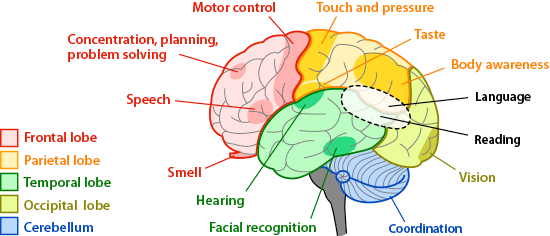
According to Inc. writer Melanie Green, the average age for a child to receive a smartphone is 10 years old, and on average 50% of children have a social media account by age 12. Furthermore, in a research study done by the Department of Psychology from both University of Pennsylvania and The City College of New York, tests were conducted to demonstrate that a child's brain doesn't function as efficiently or
Source: MD-health.com
Figure 1: The major parts of the brain and their function
frequently as an adult's does. This originates from the fact that a child's brain is just more severely under developed. This underdevelopment of the brain paired with the cyberbullying statistics is what makes this effect of humor so concerning.

Enough is Enough, an organization aimed at ending cyberbullying, reported that 33.8% of students between 12 and 17 were victims of cyberbullying. It was also reported that hospital visits from children due to attempted to suicide has doubled since 2008, which has been linked to cyberbullying. If a child's brain is not even fully developed, how are they supposed to process the attacking of another person through humor, a concept they typically understand as making someone laugh?
Source: broadbandandsearch.com
Figure 2: The percentage of cyberbullying on each social media platform
Sarcasm is cruelty in disguise, it's demoralizing someone, and finding humor at the expense of someone else. A child's brain is not biologically mature enough to handle the stress that this type of humor can cause, and they are not ready to be exposed to the amount that is found on social media. They don't have the same rational decision making decision skills that adults do, and if they see this technique used on others, they might only view it as funny and form opinions on right and wrong from it. Children are at a higher risk of manipulation from humor's effect on social media, and if this issue does not become a priority the consequences could be crippling to young children all around the world.